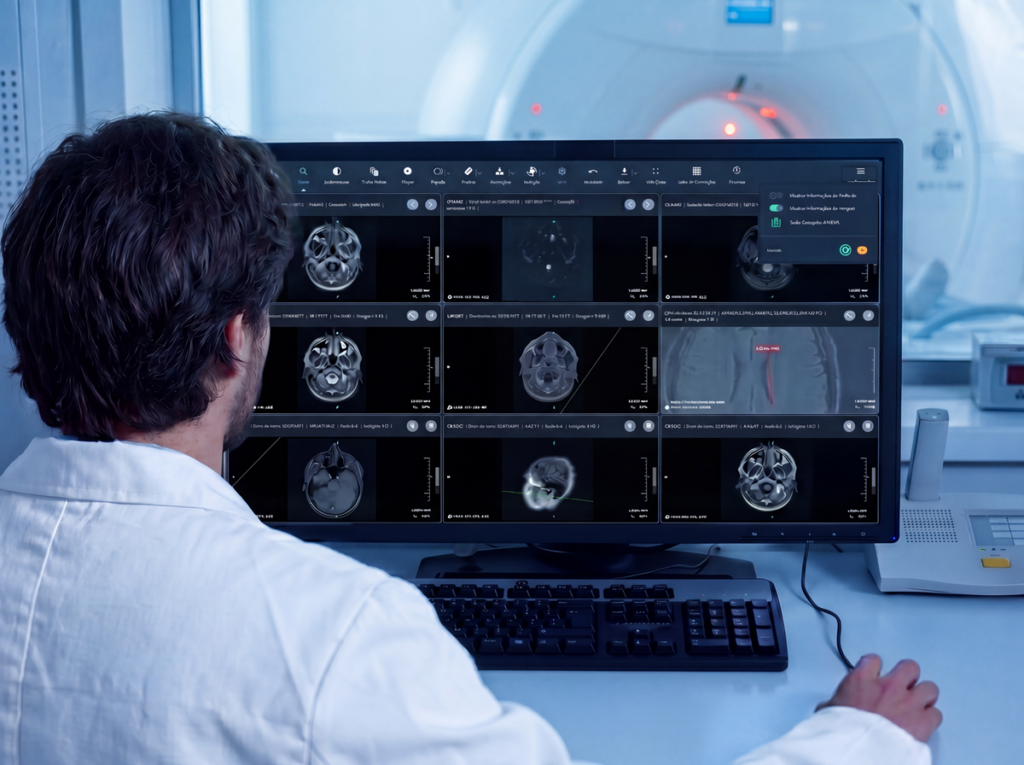

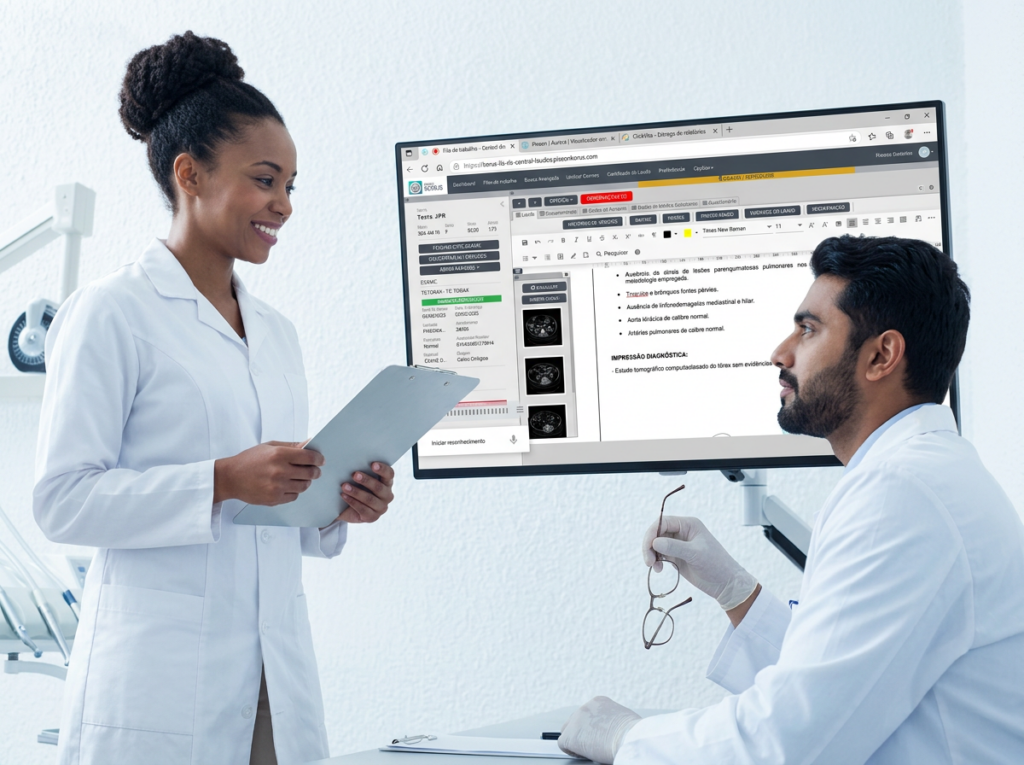

In radiology, issuing a report should not be a bottleneck. And yet, in many institutions, it still is.
The problem is not always the medical team’s capability. Very often, it is the system. Or, more precisely, the lack of an environment that allows the institution to centralize, organize, prioritize, review, and deliver reports with the agility and control that radiology practice demands today.
When reporting depends on fragmented processes, multiple tools, manual workflows, or unclear circuits, the operation loses speed. And when the operation loses speed, productivity suffers, the referring physician’s experience suffers, the patient’s experience suffers, and the institution’s ability to grow in an organized way suffers as well.
That is why more and more organizations are moving toward a more mature model: a Reporting Center that brings together the creation, management, and delivery of medical reports within a single environment. At Pixeon, our Reporting Center was developed precisely with that logic in mind: a cloud-based, flexible, configurable, and scalable platform designed to centralize report production with security, speed, and accessibility from anywhere.
What Is a Reporting Center in Radiology?
A Reporting Center in radiology is a solution designed to centralize the production, review, management, and delivery of medical reports within a single digital environment.
Instead of depending on fragmented processes, informal circuits, or disconnected tools, a Reporting Center allows the team’s work to be organized, workflows to be established, unproductive time to be reduced, and greater control to be maintained over every stage of the process.
With Pixeon’s Reporting Center, hospitals, clinics, diagnostic centers, laboratories, and healthcare networks can centralize their reporting operations within a cloud-based platform built around simple, configurable, and scalable processes. In addition, the solution is designed to be accessible from anywhere and to support both operations concentrated in one location and distributed work models.
Why a Reporting Center Is No Longer Optional
A few years ago, many institutions were still able to support report production through more manual or less integrated models. Today, that model is starting to fall short.
The pressure to deliver results faster, the increase in exam volume, the need to prioritize cases more effectively, and the demand for greater traceability all mean that a fragmented operation ends up costing too much.
It costs time.
It costs productivity.
It costs operational quality.
And it also costs experience.
That is why a Reporting Center should no longer be seen as an accessory. It should be seen as a critical layer for making radiology work with more organization, more speed, and greater responsiveness.
>> If your institution is looking to reduce friction in report production, this is an excellent time to understand how our Reporting Center works.
What Problems Does a Reporting Center Solve?
The great strength of a Reporting Center is not simply that it adds more features. It is that it solves real problems.
For example:
- delays in report generation,
- dependence on manual circuits,
- difficulty prioritizing urgent cases,
- variability among professionals,
- lack of visibility into productivity,
- delays caused by transcription or review,
- scattered clinical data,
- and limited integration with the broader radiology workflow.
When these problems accumulate, the team feels that it is working hard while moving forward less than it should. And that impacts not only the staff. It also affects the institution and the patient experience.
In that context, a centralized platform allows the institution to organize the operation and turn a historically fragile process into a more solid, measurable, and scalable workflow.
The Features That Truly Make a Difference
Not all solutions solve the same problems. That is why it is important to look closely at the features that actually change the operation on a daily basis.
Voice recognition
One of the most powerful tools for gaining time and fluidity is voice recognition.
In our article 5 Essential Tools to Streamline Medical Report Generation, we explain that this capability reduces dependence on manual transcription, accelerates clinical documentation, and increases team productivity. Within our Reporting Center, that capability is part of an approach designed to help physicians dictate and structure reports with greater agility and less friction.
Configurable workflows
Not all institutions work in the same way. Not all exams follow the same path. Not all priorities are the same.
That is why a robust Reporting Center must make it possible to configure workflows according to procedures, specialties, and urgency levels. At Pixeon, our Reporting Center is designed to support configurable and customizable workflows, as well as intelligent worklists that help prioritize institutional productivity.
Preconfigured templates, phrases, and structures
Another decisive point is the possibility of working with report templates, frequently used phrases, and predefined structures.
This helps accelerate writing, reduce unnecessary repetition, support standardization, and maintain consistency across different professionals. In this section, we show how structured models and technical terminology support can make reports faster to create while keeping institutional formats readily available.
Second opinion and clinical support
In certain contexts, the ability to request a second medical opinion adds security, control, and diagnostic support.
Our Reporting Center incorporates that possibility together with consolidated historical visibility, strengthening the clinical process and improving traceability in medical work.
Dashboards and performance indicators
What is not measured is not managed well.
That is why a mature Reporting Center should also provide dashboards and performance indicators that allow institutions to monitor individual and clinic-level productivity, as well as critical KPIs associated with reporting flow and SLA compliance. At Pixeon, that monitoring capability is part of the solution and helps turn operations into a more visible and manageable process.
Native PACS integration
Productivity increases even more when the Reporting Center does not work in isolation, but instead is integrated into the rest of the ecosystem.
With our radiology solutions, the Reporting Center integrates natively with Pixeon Aurora PACS, synchronizes exams and medical images, and allows reports to be issued remotely, increasing service productivity.
How a Reporting Center Improves Productivity Without Sacrificing Quality
This is the key question. Because speed is not useful if precision is lost. And standardization is not useful if it becomes rigid.
The good news is that a well-designed Reporting Center does not force an institution to choose between speed and quality. It makes it possible to improve both at the same time.
It makes speed possible because it organizes the workflow, removes unnecessary steps, automates parts of the process, and facilitates report creation.
It helps preserve quality because it provides more context, improves traceability, supports consistency, and makes it easier to prioritize each case correctly.
In other words, the goal is not to “produce more reports at any cost.” The goal is to create the conditions for the team to work with greater fluidity, more focus, and stronger control.
In our solutions, that improvement is supported by capabilities such as voice recognition, workflow parameterization, report templates, electronic signature, integrated stage management, and the possibility of reporting remotely within a unified digital environment. Those same pillars are reflected here.
>> Request a demo and discover how to adapt this model to your institution’s reality.
What Changes When the Operation Moves to the Cloud
The cloud is not a technical detail. It is an operational decision.
When an institution works with a cloud-based solution, it gains flexibility to access, coordinate, and manage report production with greater freedom and less dependence on rigid infrastructure. In the case of our Reporting Center, this translates into secure remote access, report creation from any authorized device and location, and an architecture prepared to support institutional growth.
In addition, the cloud supports distributed models, remote work schemes, and operations that are more adaptable to healthcare networks, multiple locations, or variable demand.
What Types of Institutions Benefit the Most?
The short answer is: more institutions than usually imagine it.
Our Reporting Center is designed for hospitals, clinics, diagnostic centers, laboratories, and healthcare networks that want to centralize report production with security, speed, and accessibility. It is also especially valuable for organizations that need to organize a high volume of exams, work with multiple professionals, or improve visibility into time and productivity.
And because the solution is scalable and configurable, it can support both institutions that are only beginning to mature their processes and organizations that already need a much more sophisticated operation.
Why Integrate the Reporting Center with Pixeon Aurora PACS?
When the Reporting Center is integrated with Pixeon Aurora PACS, the impact stops being isolated and starts being felt across the entire radiology operation.
On one hand, information circulates more effectively.
On the other hand, the physician finds a more continuous workflow between images, clinical context, and report generation.
And at the same time, the institution gains productivity without adding unnecessary complexity.
In our radiology solution page, we present that integration as part of a proposal that combines PACS, a Reporting Center, and online result delivery, with a focus on visualization, management, productivity, and remote reporting.
The Real Value Is Not in Reporting Faster, but in Operating Better
This is the most important point of all.
A Reporting Center is not valuable because it is “modern.” It is valuable because of what enables your institution to do better.
- it helps to generate reports with greater agility,
- it helps to organize priorities,
- it reduces rework,
- it improves traceability,
- it makes the physician’s work easier,
- it provides data for management,
- And it is even more valuable if it achieves all of that without compromising diagnostic quality.
That is the standard that should be expected today.
Conclusion
If your institution still produces reports through fragmented circuits, disconnected tools, or an operation that is difficult to scale, the opportunity for improvement is significant.
A Reporting Center in radiology can transform the way your team works every day. Not only because it accelerates report generation, but because it adds organization, visibility, consistency, and growth capacity.
At Pixeon, we developed our Reporting Center precisely to respond to that need: to centralize the creation, management, and delivery of medical reports within a digital environment that is simpler, more flexible, configurable, and scalable. Integrated with Pixeon Aurora PACS, the solution makes it possible to take radiology productivity to another level without losing control or quality.
>> Talk to a specialist and see how this solution can adapt to your institution’s reality.
FAQs
What is a Reporting Center in radiology?
It is a solution that centralizes the creation, management, review, and delivery of medical reports within a single digital environment, helping organize workflow and improve productivity.
What are the benefits of a cloud-based Reporting Center?
It provides secure remote access, greater operational flexibility, scalability, and the ability to manage report production from any authorized location.
How does voice recognition help in radiology?
It helps speed up report writing, reduces dependence on manual transcription, and increases the productivity of the medical team.
Why is it important to integrate the Reporting Center with PACS?
Because integration improves the continuity of the radiology workflow, synchronizes exams and images, and facilitates remote reporting with higher productivity.
What institutions can benefit from this solution?
Hospitals, clinics, diagnostic centers, laboratories, and healthcare networks that need to centralize and scale report production.
What features should a strong Reporting Center have?
Voice recognition, configurable workflows, intelligent worklists, templates, second opinion support, dashboards, and PACS integration.
What is a PACS and how does it transform the institution’s operation?
Choosing a PACS is not a purely technical decision, as it directly affects team performance, outcomes, and customer satisfaction. Read this article, where we answer this question in detail.
How can I identify the right PACS for my institution?
The right PACS for your institution should meet at least 12 essential criteria that can efficiently enhance your team’s work.
About Pixeon
Pixeon is the company with the largest software portfolio for the healthcare market.
Our solutions serve hospitals, clinics, laboratories, and diagnostic imaging centers, covering both management (HIS, CIS, RIS, and LIS) and diagnostic processes (PACS and Laboratory Interface), ensuring high performance and top-tier management in healthcare institutions.
The HIS/CIS software for hospitals and clinics, Pixeon Smart, is a complete solution that integrates the entire institution into a single system. It is also certified with the highest level of digital maturity by SBIS (Brazilian Society of Health Informatics). We already have over 3,000 clients in Brazil, Argentina, Uruguay, and Colombia, serving millions of patients annually through our platforms.Want to know if Pixeon’s technologies offer everything you’ve always wanted for your hospital or clinic? Request a commercial consultation and be amazed by everything our management system can provide!