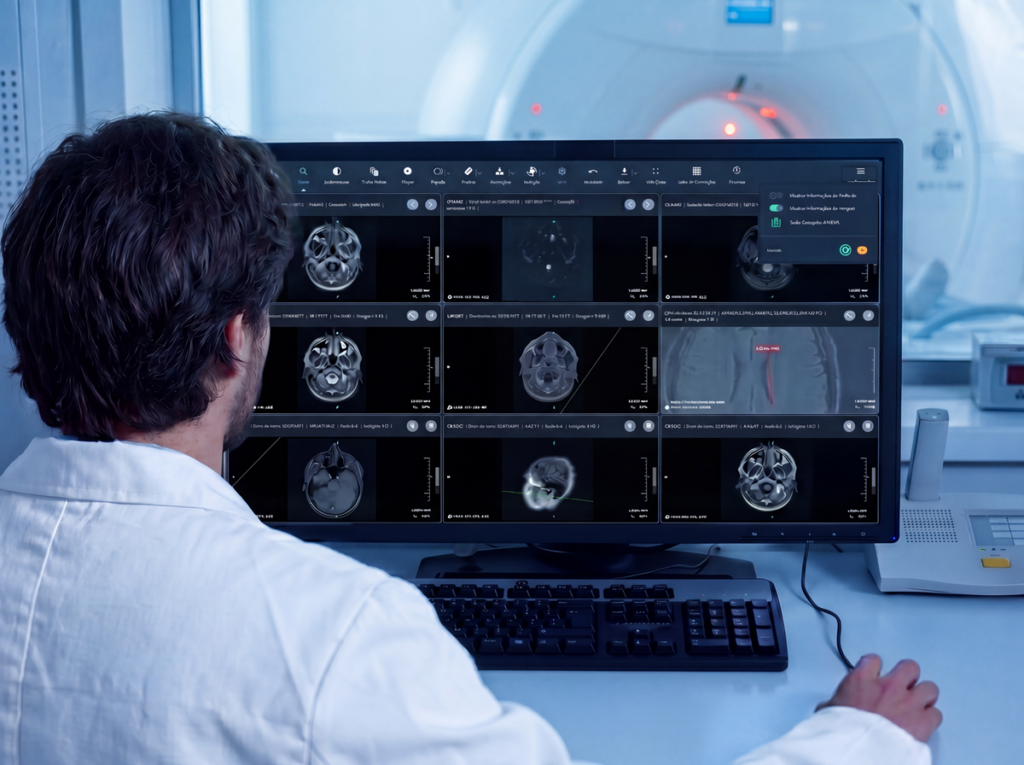



In radiology, speed matters. But being fast is not enough. It is also necessary to be precise, organized, and consistent.
That is the major challenge for many institutions that want to move toward teleradiology or remote reporting models: they discover that the real problem is not only the distance between the physician and the exam. The problem lies in everything that happens before, during, and after the report.
Because issuing reports remotely does not simply mean opening images from another location. It means having secure access, clinical context, prioritization, workflow, traceability, and delivery capacity within the same ecosystem.
That is why, when an institution needs to gain real agility, the question is no longer whether it can report remotely. The right question is different: whether it has an operation prepared to ensure that distance does not create friction.
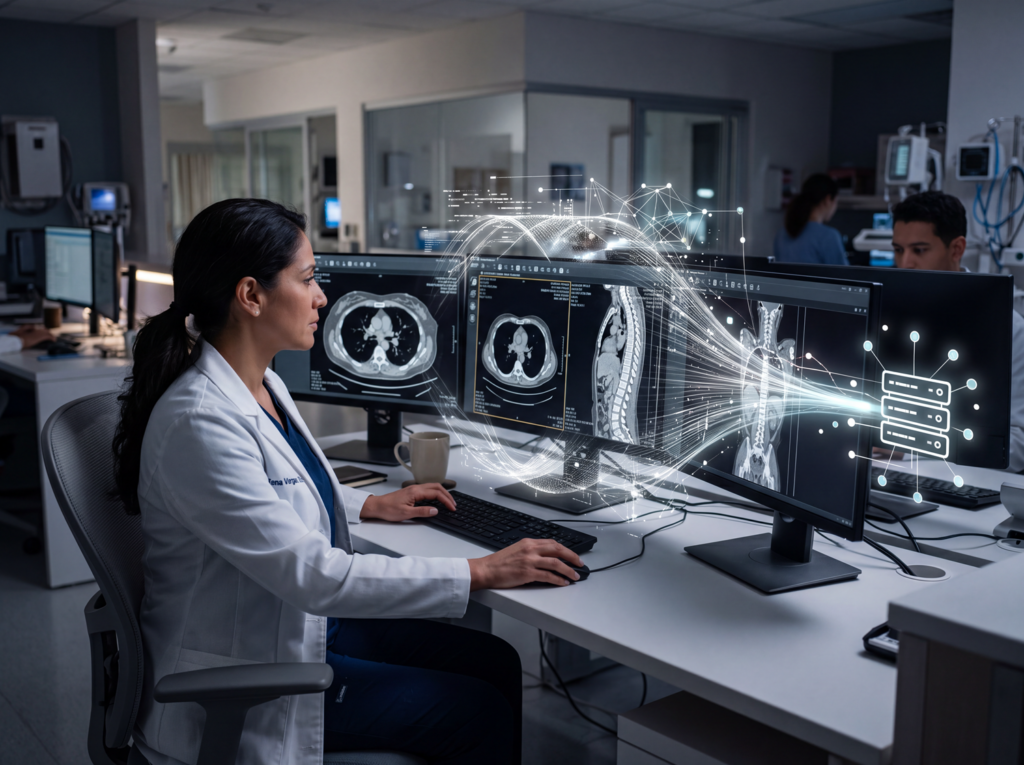
At Pixeon, we developed an integrated radiology approach that combines Pixeon Aurora PACS, Reporting Center, and online result delivery precisely to help institutions reduce response times, increase productivity, and maintain diagnostic quality even in remote work models. Our Reporting Center is a cloud-based solution for the creation, management, and delivery of radiology reports; it integrates with Pixeon Aurora PACS and allows reports to be issued remotely, increasing productivity.
Teleradiology Does Not Fail Because of a Lack of Specialists: It Fails Because of a Lack of Flow
Many institutions have already understood that working with distributed specialists can expand coverage, optimize schedules, and accelerate care. However, when remote reports rely on manual circuits, disconnected platforms, or poorly structured exchanges, the promise of agility fades.
That is where the true difference appears between “being able to work remotely” and “having a well-designed remote operation.”
An efficient teleradiology operation requires the exam, the images, the clinical context, the priority, the review flow, and the delivery of the result to connect without friction. If one of those elements fails, time is still lost. In some cases, even more than before.
With an integrated ecosystem, that journey can be organized from the start, allowing the radiologist to work with greater continuity and enabling the institution to maintain control over the entire process. The integration between PACS and the Reporting Center that we offer at Pixeon is designed precisely to synchronize exams and medical images, support automated workflows, and improve institutional productivity.
What an Institution Needs to Issue Radiology Reports Remotely
Speaking seriously about remote reporting means speaking about operational infrastructure, not only about access.
For a remote model to work well, an institution needs at least five things: secure access, integration with images and data, prioritization capability, tools to streamline report generation, and visibility into process performance.
That is why a solution prepared for this scenario should allow the institution to:
- access from any authorized device and location,
- work with configurable workflows,
- prioritize exams according to defined criteria,
- reduce friction in report generation,
- and manage every stage within a unified environment.
Our Reporting Center was designed exactly with that logic. It allows reports to be generated in just a few clicks, from any device and location, with full security; it enables configurable and customizable workflows; and it supports intelligent worklists that help organize priorities and improve institutional performance.
What Changes When the Reporting Center Is Integrated with PACS
This is the decisive point.
When the Reporting Center works in isolation, it can solve part of the problem. But when it is integrated with Pixeon Aurora PACS, the change stops being partial and begins to affect the entire operation in a structural way.
Why? Because integration removes a large portion of workflow breaks. The exam is not left “on one side” and the report “on the other.” Images and exams are synchronized automatically, the physician finds more context within the same work journey, and the institution gains continuity between visualization, interpretation, reporting, and delivery. Our radiology approach presents that integration as part of a cloud-based solution for the creation, management, and delivery of radiology reports, integrated with Pixeon Aurora PACS and oriented toward remote report generation.
In addition, when the workflow is integrated, productivity no longer depends only on the physician’s individual effort. It starts depending on a better-designed system.
And that changes everything.
Fewer Steps, Less Waiting, Less Rework
One of the greatest enemies of response time is fragmentation.
When the team needs to search for information across different platforms, wait for unnecessary confirmations, correct missing elements, or compensate for process errors, each exam takes longer than it should. Not because the diagnosis is slow, but because the circuit makes it slow.
The advantage of an integrated digital operation is that it reduces exactly those deviations. In our content, we explain how digital systems improve internal processes, speed up report generation, and support faster result delivery. In that same logic, a Reporting Center makes teleradiology possible and adds even more agility to professional work and to the patient’s timeline.
That is the kind of difference that truly affects the operation. Not a cosmetic improvement. A real improvement that can be felt in the pace of the service, in the team’s experience, and in the institution’s responsiveness.
How Technology Helps Accelerate Without Sacrificing Quality
Sometimes a false tension is presented, as though accelerating meant giving up precision.
In radiology, that cannot be accepted. And it does not need to be accepted.
The key is to use technology that improves the workflow without weakening clinical judgment. In other words, technology that removes friction, not depth. Technology that reduces unproductive time, not medical rigor.
That is why, within a mature remote operation, features such as voice recognition, workflow parameterization, report templates, electronic signature, and stage management within the same environment are so important. In this section, we explain that these capabilities increase productivity, make it possible to manage demands more effectively, support the prioritization of urgent cases, and help issue reports with greater agility and security. That same article also states that remote reporting significantly accelerates result delivery, which is essential for patient safety and well-being.
In other words, a strong remote operation does not replace medical judgment. It strengthens it.
What Benefits Your Institution Can Expect
When an institution implements a well-designed remote reporting operation, the benefits expand across several layers at the same time.
First, productivity improves. The team loses less time on secondary tasks and can focus more on clinical analysis.
Second, responsiveness improves. Exams move forward more smoothly, and the institution can reduce waiting times.
Third, operational organization improves. There is more traceability, more control, and more clarity regarding the status of each report.
Fourth, the experience of physicians and patients improves. A more organized and agile workflow translates into better communication, fewer delays, and a stronger perception of service quality.
At Pixeon, we designed our Reporting Center to respond to these needs with a cloud-based solution, accessible remotely and securely, integrated natively with Pixeon Aurora PACS, and oriented toward institutional productivity.
>> Request a demo and discover how this model can adapt to the reality of your radiology service.
What Types of Institutions Benefit the Most from This Model
Teleradiology is not only for large networks or highly complex structures.
This model can generate significant value in hospitals, clinics, diagnostic centers, laboratories, and healthcare networks that need to centralize reports, gain operational flexibility, and respond better to variable or distributed demands. It is also especially useful when there are multiple sites, a need for remote coverage, growing volume, or greater pressure on delivery times.
Our Reporting Center was launched to address exactly that type of context, with a cloud-based, configurable, scalable solution that can support centralized reporting workflows across different institutional realities.
The Real Goal Is Not Simply “Doing Teleradiology”
This should be stated clearly.
The goal is not simply to “do teleradiology.” The goal is to build an operation that responds better:
- that delivers faster,
- that prioritizes better,
- that maintains quality,
- that does not depend on patchwork,
- that can grow,
- And that turns distance into an advantage, not an obstacle.
That is why, when an institution evaluates this path, what matters is not only whether it can work remotely. What matters is the system it will use to do so.
Conclusión
Remote radiology should no longer be seen as a contingency solution. It should be seen as a concrete opportunity to improve productivity, accelerate response times, and expand care capacity with greater organization and control.
But for that to happen, it is not enough to have specialists working remotely. What is needed is an integrated, secure, traceable workflow prepared to sustain the real pace of the operation.
At Pixeon, we integrate Reporting Center and Pixeon Aurora PACS so that your institution can issue radiology reports remotely, reduce response times, and move toward a radiology model that is more productive, flexible, and scalable. Our cloud-based solution is designed for the creation, management, and delivery of radiology reports, with native integration, secure remote access, and a focus on institutional productivity.
Talk to a specialist and see how this solution can support the evolution of your service.
FAQs
What is teleradiology?
Teleradiology is a working model that allows exams to be interpreted and reports to be issued remotely, as long as there is a secure environment connected to images, data, and the clinical workflow. Pixeon’s Reporting Center integrated with Pixeon Aurora PACS is designed precisely for remote radiology report generation.
What is needed to issue radiology reports remotely?
Secure access, integration with images and clinical data, configurable workflows, tools to streamline report creation, and management capability within a unified environment are all necessary. Pixeon’s solution offers report generation in just a few clicks, access from any authorized device and location, and intelligent worklists.
Why is it worth integrating the Reporting Center with PACS?
Because integration synchronizes exams and medical images, improves continuity between visualization and reporting, and helps increase service productivity.
How does this integration help reduce response times?
By reducing manual steps, eliminating workflow breaks, and enabling a more continuous operation between images, reporting, and delivery. Pixeon’s materials explain that digital systems improve reporting speed, security, and faster result delivery.
Which tools help accelerate report generation without compromising quality?
Voice recognition, workflow parameterization, report templates, electronic signature, and integrated stage management all help improve agility, security, and productivity.
What institutions can benefit from this model?
Hospitals, clinics, diagnostic centers, laboratories, and healthcare networks that need to centralize reports, work with more flexibility, and improve response times can benefit from this model.
What is a PACS and how does it transform the institution’s operations?
Choosing a PACS is not a purely technical decision, as it directly affects team performance, outcomes, and customer satisfaction. Read this article, where we answer this question in detail.
How can I identify the right PACS for my institution?
The right PACS for your institution should meet at least 12 essential criteria that can efficiently strengthen your team’s performance.
What is a Reporting Center in radiology and how can you increase productivity without compromising diagnostic quality?
A Reporting Center in radiology is a solution designed to centralize the production, review, management, and delivery of medical reports within a single digital environment. We have a full article where we answer this question in detail. You can read it here.
About Pixeon
Pixeon is the company with the largest software portfolio for the healthcare market.
Our solutions serve hospitals, clinics, laboratories, and diagnostic imaging centers, covering both management (HIS, CIS, RIS, and LIS) and diagnostic processes (PACS and Laboratory Interface), ensuring high performance and top-tier management in healthcare institutions.
The HIS/CIS software for hospitals and clinics, Pixeon Smart, is a complete solution that integrates the entire institution into a single system. It is also certified with the highest level of digital maturity by SBIS (Brazilian Society of Health Informatics). We already have over 3,000 clients in Brazil, Argentina, Uruguay, and Colombia, serving millions of patients annually through our platforms.Want to know if Pixeon’s technologies offer everything you’ve always wanted for your hospital or clinic? Request a commercial consultation and be amazed by everything our management system can provide!